MOT stands for Ministry of Transport, the government department that introduced the test in 1960. The MOT meaning today is simple: an annual roadworthiness and emissions check that most cars, vans and motorbikes in Great Britain need once they are old enough. It is carried out at an approved test centre and overseen by the DVSA. You can see any vehicle's record with the free MOT history checker.
Part of MOT Status & Expiry. Start with the main guide: MOT Check: Status, Expiry and Test Results
Updated October 2026 · Independent information, not legal advice
The test is often misunderstood. It is not a service, it does not guarantee the engine or gearbox, and a pass only describes the vehicle on the day it was tested. The answers below explain the MOT meaning UK drivers usually need: what the letters stand for, what is tested, how results work and where the edge cases sit.
What Does MOT Stand For
MOT is short for Ministry of Transport. The ministry has been renamed and merged several times since, so the letters are now a historical label rather than a department name.
Why the name survived
The test became known as "the MOT" long before the department changed, and the name stuck with drivers, garages and legislation.
- Official records now sit with the DVSA in Great Britain
- The letters are still printed on every MOT certificate
Is it a service or a legal check
Despite what some garages' signs suggest, the letters describe a legal inspection and nothing about maintenance. Knowing that helps you judge quotes sensibly: a test fee pays for the inspection, while repairs and servicing are separate work you choose to approve.
MOT Meaning Car Owners Should Know
For a car owner, the MOT meaning car drivers care about is legal: a valid certificate is normally needed to drive on the road, and it proves the vehicle met minimum standards on test day.
What it is not
It is not a warranty, a service or a guide to value.
- It does not cover the clutch, gearbox or engine internals in detail
- It does not replace routine servicing
What the certificate proves
It proves that a qualified tester inspected the vehicle and recorded a result on a particular date. Insurers, buyers and the police can all rely on the record, but none of them should read it as a full mechanical report.
MOT Meaning In The UK
The MOT meaning UK wide is slightly split. MOT in England, Scotland and Wales is run through the DVSA. Northern Ireland has its own separate test run by the DVA, so the record works differently there.
Great Britain versus Northern Ireland
The free lookup covers Great Britain records. For Northern Ireland, see MOT in Northern Ireland.
What Is MOT In England
What is MOT in England is the same question as in Scotland and Wales: a legal annual check at a DVSA-authorised garage. Rules are set nationally across Great Britain, so a pass in Leeds is as valid as one in Cardiff.
- Tests are booked directly with a garage
- Results go onto a central record that anyone can search by registration
What Is MOT In UK Terms
In plain terms, what is MOT in UK law is a certificate showing that a vehicle met minimum roadworthiness and emissions test standards when inspected. The legal duty to hold one is explained on GOV.UK.
Key idea
The certificate is a snapshot, not a promise about next month.
Who sets the standards
Standards are set nationally and published for testers in a manual, so the same fault should lead to the same result at any approved garage. If you think a fail was unfair, there is an appeals route, explained on GOV.UK.
When A Vehicle Needs Its First MOT
A new car normally needs its first MOT test by the third anniversary of first registration. Vans and motorbikes follow similar timing, but some classes differ, so check GOV.UK for your vehicle.
Quick ways to confirm timing
- Look at the MOT expiry date in the online record
- Read the date of first registration on the V5C
- Use when is my MOT due for the practical steps
Vehicles that differ
Some vehicles, such as taxis or ambulances, are tested earlier than three years. Imported or re-registered vehicles may have different first-registration dates, so check the record rather than assuming the age from the plate.
MOT Requirements At A Glance
The basic MOT requirements are a vehicle of testable age, a registration document, and a test at an authorised centre. Some categories are exempt, such as certain historic vehicles.
- Bring the vehicle reasonably clean and with enough fuel
- Make sure warning lights are not on
- Check the exemption rules in MOT age exemption
Documents and preparation
You do not normally need the V5C to book a test, but a current registration number is essential. Clear any items stored in the boot and remove loose objects that could affect the tester's access to seatbelts and mirrors.
MOT Rules UK Drivers Often Mix Up
The MOT rules UK drivers misremember most are about timing. You can usually test up to a month before expiry and keep the same renewal date, but testing earlier than that normally resets the date.
Common myths
- "A pass means the car is mechanically sound" is not true
- "An MOT covers the whole car" is not true either
Driving to a test
Driving to a pre-booked test is usually allowed even if your certificate has expired, provided the vehicle is otherwise roadworthy and insured. Driving elsewhere without a valid certificate may risk a fine. Read MOT grace period to see what people wrongly assume.
What Is Tested In An MOT
What is tested in an MOT is a defined list of safety and environmental items. The test is largely visual and functional, with some road-wheel and machine checks. Testers follow a published manual.
The broad areas
- Lights, indicators and horn
- Brakes, steering and suspension
- Tyres, wheels and seatbelts
- Bodywork condition and structure
- Exhaust and emissions test
- Visibility, including wipers and mirrors
What sits outside the test
Engine condition, gearbox wear, clutch operation and most electronic comfort features are outside the test. A garage can advise on those separately, but they will not usually cause a fail.
What Is Checked During An MOT Inside The Car
What is checked during an MOT is not only under the vehicle. Testers also look inside.
- Seatbelts and their mountings
- Seats and security of the driver's controls
- Warning lights and the MOT display panel
- Doors, which must open and close properly
Dashboard and controls
The tester checks that steering column locks and horn work and that the dashboard shows no relevant warning lights. Airbag or ABS warnings can cause a fail, so do not ignore a lit symbol before the appointment.
What Gets Checked In An MOT Test Underneath
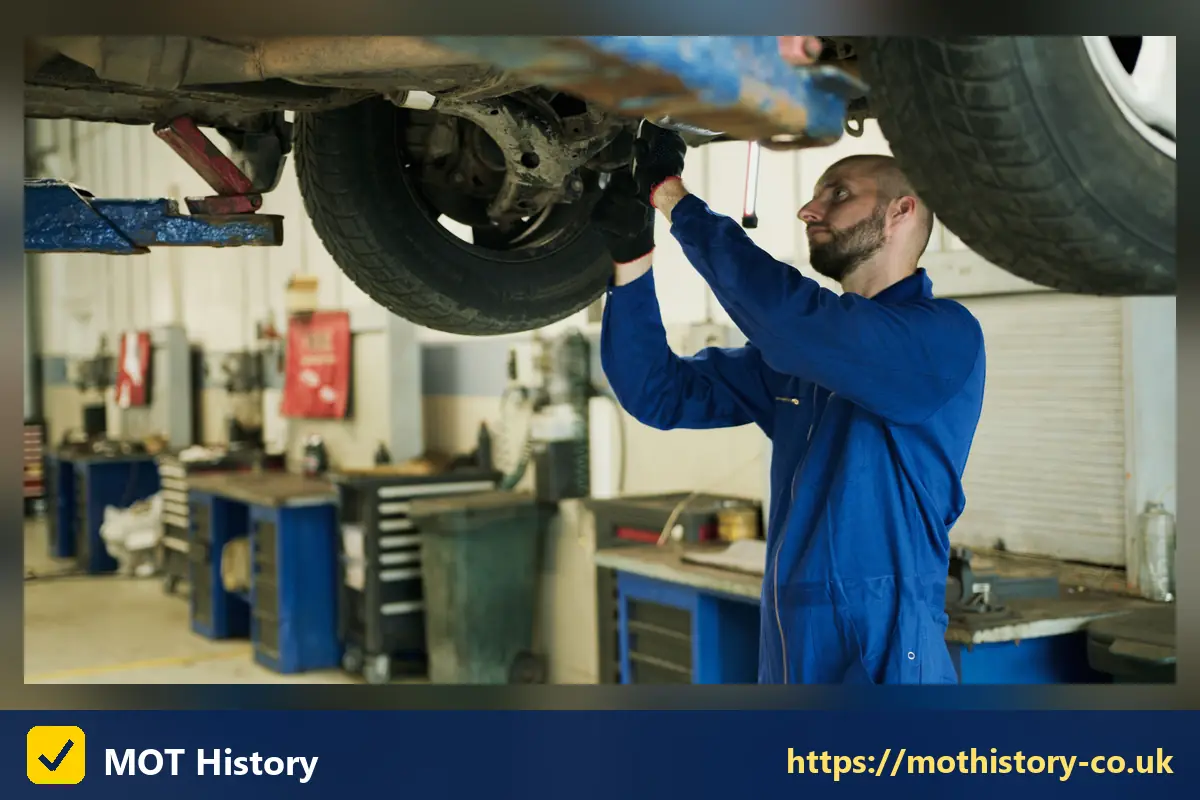
What gets checked in an MOT test underneath covers parts most owners rarely see. The vehicle is raised on a lift or placed over a pit.
Underside items
- Brake pipes and discs for corrosion or leaks
- Suspension arms, springs and bushes
- Exhaust mountings and corrosion
- Steering components and joints
Corrosion rules
Corrosion only matters where it affects structural strength near key mounting points, so surface rust on a panel will not usually fail a vehicle. Heavy rot near a suspension mount certainly can.
What Does MOT Test On The Outside
What does MOT test outdoors is the lighting, glass and body. Sharp edges, damaged panels or a cracked windscreen in the driver's view can lead to a major defect.
- Number plate condition and legibility
- Windscreen chips in the swept area
- Wiper blades and washer operation
Bodywork and security
Sharp or protruding edges that could injure someone, loose bumpers, and insecure door handles can all be recorded. A dented wing is fine; a dented wing with a jagged edge is not.
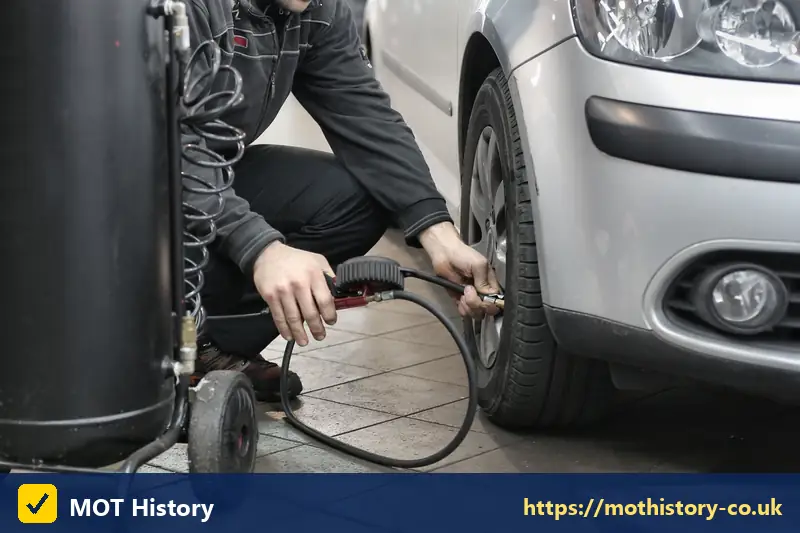
The Tyre And Wheel Check
Tyres must have enough tread, sit properly on the rim and be free of cuts and bulges. Mismatched construction on one axle can also cause a failure.
Why it matters
Tyres are one of the most common reasons vehicles receive a fail. A quick check of tread before the test is sensible, and the pre-MOT checks you can do yourself cover it.
Tread, damage and pressure
The legal minimum tread depth applies across the central part of the tyre, and cuts or bulges in the sidewall are reason to fail. The tester does not normally measure pressure, but underinflated tyres can affect the brake test.
The Brake Check
Brakes are tested for efficiency and balance on a roller or plate machine, and the condition of pipes and pads is inspected. A pull to one side can cause a fail.
- Handbrake or parking brake is also tested
- Fluid leaks are noted
What brake results mean
A low efficiency reading or large difference between wheels shows up as a defect, while a slightly worn pad may only produce an advisory. Fixing it before the retest often requires just a brake service.
Lights And Signalling
All required lights must work and be correctly aimed. Headlight aim is tested with an alignment tool.
Frequent light failures
- Blown bulbs on brake lights or number plate lamps
- Misaligned headlights after a bulb change
- Faded or cracked lenses
Easy wins before the test
Ask a friend to stand behind the car while you press the brake pedal and cycle through indicators. Replacing a bulb yourself is cheap and can avoid a fail that would otherwise add a retest to your day.
Emissions And Exhaust
The emissions test measures exhaust gases against limits that depend on age and fuel type. Diesel cars also have a smoke check, and a visible DPF fault can fail.
- Check the engine warning lamp is not lit
- A healthy service beforehand helps
Why diesels can struggle
Short town-only journeys can clog a particulate filter, which may cause a smoke test fail. A longer motorway run beforehand is a common tip, though it is no guarantee. Look at co2 emissions checker for what a registration reveals about emission data.
Pass, Fail And Advisory
Every test ends with a pass, a fail, or a pass with notes. The notes may include an advisory or a minor defect, which do not stop a pass but warn you to keep an eye on something.
Reading the wording
- Advisory: something worn or likely to fail soon
- Minor defect: a small fault that does not fail the test
Advisories are worth reading carefully, because they are the tester's early warning. A tyre close to the legal limit or a slightly weeping shock absorber may be fine today and a fail next year. Keep a note of each one and ask a garage to look at it at your next service.
Major And Dangerous Defects
A major defect means a fail, and you should get it repaired. A dangerous defect means the vehicle should not be driven until fixed, because it is a direct risk to road safety.
Why the distinction matters
You could face penalties for driving a vehicle with a dangerous defect. For the detail, see can you drive with a failed MOT.
Retest Basics
If a vehicle fails, a retest is often available within a set period at reduced or no cost, depending on timing and what was repaired. The exact rules are on GOV.UK.
- Leaving the vehicle at the garage for repair usually keeps the retest simple
- Taking it elsewhere may need a full new test
Keeping it simple
Note the defect list on your failure sheet, ask for a written quote, and ask how long the retest window is at that garage. That avoids surprise costs and delays.
How Long An MOT Takes
A standard car test commonly takes under an hour, although busy centres may need the vehicle for longer. Look at how long does an MOT take for typical timings.
Planning
- Allow extra time if repairs are likely
- Ask the garage what they recommend for waiting
How Long A Certificate Lasts
A MOT certificate is normally valid for 12 months. You can usually test up to a month early and keep the same renewal date. See how long is an MOT valid.
What happens after expiry
The vehicle needs a new test. Driving without a valid MOT can risk penalties, except when travelling to a pre-booked test or repair in some circumstances.
Planning your renewal
Set a reminder a few weeks before expiry and book early. If you pass up to a month before expiry, the new certificate normally starts from the old expiry date, so early booking rarely costs you time.
MOT Classes
Vehicles are grouped into test class categories. A car is usually class 4, while motorbikes and larger vehicles sit in other classes with different checks.
- Motorbikes are covered in motorbike MOT guide
- Find yours with MOT classes explained
Why class matters
Class determines which checks apply, for example whether a passenger vehicle is tested for seatbelts, or whether a motorbike is tested for its sidecar. Choosing the wrong class at booking can cause confusion at the garage.
| Vehicle type | Usual class | What differs |
|---|---|---|
| Car | Usually class 4 | Seatbelts and passenger checks |
| Motorbike | Lower classes | No seatbelts, different brake tests |
| Motorbike with sidecar | Its own class | Sidecar attachment is checked |
| Larger vehicle | Higher classes | Different checks, check GOV.UK |
Finding A Test Centre
An approved test centre displays a blue sign with three white triangles. You can search for one online or ask friends for recommendations.
Choosing wisely
- Look for centres that explain failures clearly
- Avoid anyone who pressures you into unnecessary work
Local search
A quick look at MOT near me explains what to look for when choosing a garage, and checking reviews and opening hours helps avoid wasted trips.
What An MOT Certificate Looks Like
A MOT certificate lists the vehicle, test date, result, mileage and expiry date. Older paper forms carried codes like VT20 for a pass and VT30 for a fail, though records are now mostly digital.
Getting a copy
Information on replacing a certificate is at MOT certificate.
Digital first
Most people now rely on the online record and text reminders rather than a paper certificate. Keep a photo of the paper copy anyway, in case of connection problems or a dispute.
The Record Behind The Certificate
Every result is stored in the MOT history held by the DVSA. That means you can view results, mileage readings and past advisories for free through an online search.
- Useful when a paper certificate is lost
- Helpful when buying used
What the record includes
Each test entry shows the date, result and mileage, plus any advisories, minor defects and failures recorded. Recorded items are listed by the tester's wording, so two records may describe the same fault differently.
Checking MOT History Before Buying
Looking at MOT history helps you see patterns such as repeated advisories or odd mileage gaps. See mileage check for what the odometer readings can reveal.
Red flags
- Mileage that goes down
- Long gaps between tests
- Repeated failures on the same item
Turning the record into questions
If you spot a repeated advisory about corrosion or brakes, ask the seller what was done about it, and ask to see invoices. A seller who can answer clearly is more trustworthy than one who shrugs.
MOT And Used Car History
An MOT record is one part of a wider check. It does not show finance or write-offs. For those, use a full used car lookup by reg or a dedicated data check.
MOT, Service And Warranty
People mix up the test with a service. A service is maintenance you choose; the test is a legal check. Some garages offer both together, discussed in car service and MOT.
- A service may prevent failures
- A pass does not replace a service
If you are buying used, a recent pass is reassuring but not a replacement for a mechanical inspection. A service record shows how the vehicle has been looked after, while the MOT record shows what a tester saw on specific days. Together they paint a far better picture than either alone.
Common MOT Myths
A few beliefs keep circulating, and several are wrong.
Myths to drop
- "You cannot drive on the last day" is false; the certificate runs until its expiry date
- "New tyres guarantee a pass" is false
- "An MOT covers the clutch" is false
One more belief deserves correcting: that a fresh pass from one garage can be overturned by another. Each test is a separate inspection, so a different tester may notice something new. That is why the wording of advisories and the test date matter more than the headline result.
Electric And Hybrid Vehicles
Electric vehicles still need an MOT. They skip the exhaust emissions test but are checked for brakes, steering, lights and tyres, and battery or high-voltage condition is visually assessed. Ask the garage whether it is set up for electric vehicles.
What to ask the garage
Ask whether the test centre has experience with your model and whether it will check for damaged cable insulation visible underneath. A centre that routinely tests electric vehicles will usually be happy to explain.
Motorbikes, Vans And Other Vehicles
Motorbikes have their own rules, and vans and minibuses have different classes. Always confirm the class first using what MOT class is my vehicle.
Classic vehicles
Many older vehicles are exempt, but safety remains the owner's responsibility.
Frequently Asked Questions
What does MOT stand for?
MOT stands for Ministry of Transport, the government department that created the test in 1960. The department has since been restructured, and the test is now overseen by the DVSA in Great Britain, but the abbreviation is still used in law and everyday speech across the UK.
What is the MOT meaning in the UK?
In the UK, an MOT is a mandatory annual inspection showing a vehicle met minimum roadworthiness and emissions standards on the day it was tested. It is usually needed once a vehicle reaches a certain age, and the detail is set out on GOV.UK for different vehicle types.
What is an MOT test in England?
In England the test is the same as in Scotland and Wales. It is carried out at an approved test centre, recorded centrally by the DVSA, and produces a pass or fail. A pass gives you a certificate that is usually valid for 12 months.
What is tested in an MOT?
The test covers safety and environmental items such as brakes, steering, suspension, tyres, lights, seatbelts, bodywork, exhaust emissions, mirrors and windscreen visibility. It does not include a deep inspection of the engine, gearbox or clutch, so it is not a full mechanical health check.
What is checked during an MOT?
Testers inspect the vehicle from outside, inside and underneath. They look at lamps, number plates, seatbelts, warning lights, wipers, tyres and brakes, then check the structure and exhaust. Results are entered onto the national record and a certificate is issued if the vehicle passes.
What gets checked in an MOT test for diesel cars?
Diesel vehicles receive the same core safety checks as petrol ones, plus an exhaust smoke test. Testers also look at emissions-related equipment such as a diesel particulate filter where fitted. A warning light or visible tampering with that equipment can lead to a fail.
What are the MOT requirements?
The basic requirements are a vehicle of testable age, an approved test centre and a booked appointment. The vehicle should be presentable, have fuel, and be free of warning lights where possible. Exemptions exist for certain vehicles, so confirm your position on GOV.UK.
What do MOT rules say about testing early?
You can usually have a test up to a month before the current certificate expires and still keep the same renewal date. Testing earlier than that normally resets the expiry to 12 months from the new test, so you may lose some validity.
Does an MOT pass mean the car is safe?
A pass means the vehicle met the minimum standard on test day. Faults can develop afterwards, and the test does not cover everything, such as internal engine wear. Regular servicing and checking tyres and fluids between tests remain important for safety.
What is the difference between an advisory and a major defect?
An advisory is a note about something worn or close to failing, and it does not stop a pass. A major defect is a fault serious enough to fail the test and needs repair. A dangerous defect means you should not drive the vehicle until it is fixed.
Can I check MOT history for free?
Yes. In Great Britain you can view the MOT history for a vehicle by entering its registration number into the free checker. It shows test dates, results, advisories and recorded mileage. It does not show insurance, finance or write-off status, which come from other checks.
Is the MOT the same in Northern Ireland?
No. Northern Ireland has its own separate test run by the DVA, and records are held separately from the Great Britain database. The general idea is similar, but booking, rules and records differ, so follow DVA guidance if your vehicle is registered there.
Official Sources
Rules, fees and deadlines change. Confirm anything that affects your money or legal position with the official service.